Discover the best of Peru nature and archaeology with InkaNatura Travel. Includes detailed travel information, itineraries and photos from Tambopata National Reserve, Manu, the Inca Trail to Machu Picchu, Choquequirao, Chiclayo, The Lord of Sipan & The Royal Tombs of Sipan Museum, Tucume, Trujillo, Chan Chan, Chachapoyas, Lake of the Condors, the impressive Kuelap fortress , Mancora and Punta Sal.
Friday, April 15, 2011
The Dakar 2012 route announced: Will finish in Lima, Peru
Tuesday, April 12, 2011
Chan Chan citadel, Huaca del Sol y la Luna received visitors on election day
Over 95,000 people visited Machu Picchu exhibition in first week
Wednesday, April 06, 2011
Machu Picchu featured in Nat Geo's April issue
Kultur releases documentary on Machu Picchu
Tuesday, April 05, 2011
Vargas Llosa visited Lord of Wari treasures in
Machu Picchu artifacts exhibition opens today at Government Palace
Monday, April 04, 2011
Peru's Jorge Chavez named best airport in South America
Gastronomy House boosts tourism in downtown Lima
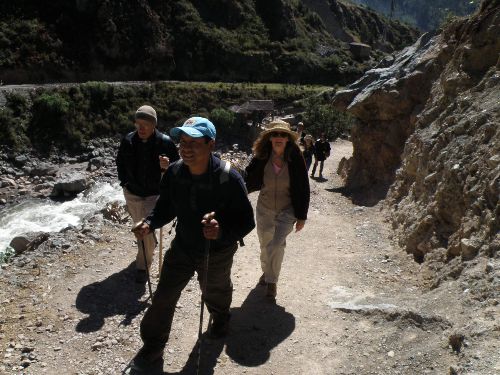
Tourists encouraged to hike Inca Trail to Machu Picchu
Tuesday, March 22, 2011
Lima, Peru: The 'City of Kings' reigns again
“Lima must have one of the most fabulous sunsets in the world. It helps, of course, that the city faces due west across the Pacific, so the setting sun can flood into the beaches and pick out the last surfers elegantly essaying a few lines,” the report says.
Up above on the cliffs, paragliders spiral past the smoked-black windows of the nearby hotels, many of which have infinity pools on their rooftops.
It all seems very Californian. The crowds promenading along the seafront eating ice cream and taking in the spectacle have a prosperous feel.
The article also highlights Lima's boom in recent years. "Even the taxi drivers no longer have anything to complain about," it states.
Peru, like neighboring nations Chile and Brazil, has largely missed out on the worldwide recession, helped by strong mineral exports and a surprisingly conservative banking system.
The report also recounts how the Shining Path years – when the country was terrorised by Maoist revolutionaries – seem to be a distant memory.
Richard Gere unable to climb Huayna Picchu due to bad weather
Cusco, Mar. 16 (ANDINA). For the second time in a row, Hollywood star Richard Gere visited the Inca citadel of Machu Picchu, one of the most spectacular icons of the ancient world, but was unable to climb the Huayna Picchu or “Young Mountain” due to bad weather conditions, local sources reported.
He was scheduled to climb Huayna Picchu mountain (2,667 meters), which looms over Machu Picchu, after touring the citadel located within the historical sanctuary, declared World Cultural and Natural Heritage.
Huayna Picchu is the eternal guardian of the Machu Picchu Sanctuary. The pathway to Huayna Picchu starts in the main square of Machu Picchu between the caretaker’s hut and the Sacred Rock, also known as the Funerary Rock and continues along a path built by the Incas.
The 61-year-old actor arrived in the town of Aguas Calientes aboard the luxurious Hiram Bingham train at 13:00 hours on Monday and entered the Inca citadel two hours later.
Tuesday, March 15, 2011
Three personages depicted on recently found polychromatic murals in Peru
The discovery was made after a group of archaeologists resumed preservation and maintenance works at the archaeological complex located 39 kilometers (24 miles) from the city of Chiclayo.
Finds were presented to the press by the director of Royal Tombs of Sipan Museum Walter Alva after their recent discovery.
The finds are the latest in the series of discoveries over the past 28 years, adorned with feathers and a kind of false wings that remind us the image one of the Lambayeque golden jewels: The Tumi.
“It’s unique for this type of mural in ancient Peru,” Alva said, noting another mural in which personages are shown amid a festive scene.
Monday, March 14, 2011
Taca Airlines to start flights to Chiclayo, Piura in May
Taca will introduce a direct flight between Lima and Chiclayo, as the capital of northern Lambayeque region has seen a significant growth in tourism and trade.
This route will start operating from May 9 with seven flights per week.
Moreover, the company will link cities of Lima and Piura with two direct and daily flights.
Taca Airlines plans to hold a 15 percent share of the country’s commercial aviation market by the end of 2011. For this purpose, it has invested some US$138 million in fleet, structure, offices, jobs and trainings, among others.
Taca also announced that the flight frequency between Trujillo and Lima will increase from seven to fourteen weekly services.
Orchid tourism in Peru has great potential, expert says
A decade from now, and with enough work and research, orchid tourism in Peru could have a privileged status in the world and generate significant income for the country, said orchid speciality Jesús Purisaca. Purisaca was the lead organizer of the first scientific Orchid Conservation Conference, which took place at Machu Picchu at the end of February.
“[Orchid tourism] is a very important niche, and it needs to be promoted and spread throughout all spheres,” he said. Purisaca, a representative of the NGO Inka Terra Association, said that a list of species needs to be compiled with the respective locations where each one can be found, in order to promote individual types as well as have specialized personnel who can explain the diversity and richness of the flowers.
He said that to guarantee the success of this kind of eco-tourism in Peru, this kind of research must be complemented with facilities for visitors, ensuring they have all the necessary comforts to make their stay in Peru an unforgettable experience.
“We have several sites where we could develop orchid tourism, and even more places yet to be discovered,” he said.
According to Purisaca, there are 40,000 people involved in the study of orchids throughout Latin America, only 500 of which are in Peru.
Thursday, March 10, 2011
Peruvian ancient temple reveals secrets of human sacrifice
“We are talking about an area that is over 600 meters squared where rituals of human sacrifice or offering have been carried out that were very important in Lambayeque society,” Bruning Museum director Carlos Wester was quoted as saying by NTDTV.
Wester added that “it is probable they were carrying out human sacrifices here because we are very close to a site where we found more than 30 sacrificed women, a very large ceremony for these past societies and this seems to be the central atrium where these rituals were carried out."
The Lambayeque or Sican culture developed on the northern coast of Peru between about AD 700 and 1300, thriving to 900-1000, between the Moche and Chimu cultures.
Monday, March 07, 2011
Lord of Wari treasures dazzled over 5,000 domestic, foreign tourists in Cusco
The Lord of Wari was recently discovered in the archaeological complex of Espiritu Pampa in Vilcabamba, Cusco.
The Wari noble, also known as the Lord of Vilcambamba, was discovered inside a tomb wearing a breastplate, bracelets, scepters, feathers, ceramics, gold, silver and textiles from the Wari culture, said Luis Fernando Bobadilla, tour guide at the aforementioned museum.
About 80 percent of visitors are locals, while the rest come from Argentina, Colombia, Brazil, Chile and the United States. They are astonished as the new find make them revise part of traditional Peruvian history. They also express their congratulations on the archaeological work carried out in the area by signing a visitor's book.
According to the discoverer and archaeologist Fonseca Santa Cruz, the Lord of Wari exhibition will run until March 9. People of Cusco may access the museum for free by showing their ID card; whereas tourists will have to buy their tickets. It opens from 08:00 to 17:00 hours.
Some 100,000 tourists go all over the Andes to enjoy carnivals
Hotels and restaurants remain full during these weeks, in spite of the consistent tourism investment growth each year.
Investment in the hotel industry is still modest. However, inhabitants make efforts to improve the quality of accommodation services, food and other available services for tourists.
Cajamarca´s carnival is the most famous celebration in our country. It features cultural and traditional expressions, dazzles visitors with krewes, parades, mask dances, neighborhood contests and colorful parades.
The city offers 117 accommodation facilities; with a total of 2,114 rooms and 4,465 beds, but only 14 are three-to-five-star graded.
Saturday, March 05, 2011
Machu Picchu
Experts believe that Machu Picchu was one in a series of royal Inca estates built in the Urubamba Valley. To researchers, the site’s multiple observation points suggest that the Inca worshipped the sun, and its location, surrounded by rivers and mountains, indicates a reverence for nature.
Thursday, March 03, 2011
Visit Peru's festivals: November and December 2011
Tourist Week in Palpa
Location: Ica
Date: November 1 - 7
The town of Palpa annually celebrates Tourist Week with food contests, handicraft fairs, guided tours through local tourist sites and its popular Ms. Tourist Week Queen beauty pageant.
Tourist Week in Puno
Location: Puno
Date: November 2 - 8
The city of Puno celebrates Tourist Week with several vibrant folkloric dance exhibitions, food fairs, parades and a huge tourism and handicraft fair.
Anniversary of the City of Puno
Location: Puno
Date: November 4
The city of Puno celebrates its anniversary with several cultural activities including folkloric dance parades; a reenactment of Manco Cápac and Mama Ocllo emergence staged in Lake Titicaca as well as concerts by popular national music bands and food fairs.
Emergence of Manco Capac and Mama Ocllo
Location: Puno
Date: November 5
The legend of Manco Capac and Mama Ocllo, who emerged from the waters of Lake Titicaca to found the Inca Empire, is staged annually in the waters of Lake Titicaca as one of Puno's main anniversary celebrations. More than 200 artists take part in this production where the mythical couple arrives in Puno's port in giant reed boats, followed by more than a hundred rafters.
The mythical Inca king and queen arise from Lake Titicaca in a yearly celebration in Puno. (Photo by Nathan Paluck)
Anniversary Tourist Week in Moquegua
Location: Moquegua
Date: November 20 - 26
The city of Moquegua organizes a series of cultural events for its Anniversary Tourist Week celebration, including its famous Amacerado de Damasco brandy contest, regional dance contests and its annual craft, tourist and industrial fair.
Jubilee and Tourism Week in Pasco
Location: Pasco
Date: November 21 - 30
The city of Pasco hosts many activities during this week, there is its famous annual crafts, agriculture and tourism fair; many folkloric shows; dog expos, a coffee and maca sampling event; an archery contest, races and food contests.
Tourist Craft Fair in Tumbes
Location: Tumbes
Date: November 22 - 26
Every year, Tumbes hosts a large craft fair to help promote tourism and exportation throughout the region.
Anniversary of Tumbes
Location: Tumbes Date: November 25
On this day, the entire region of Tumbes takes the day off and participates in sport contests, concerts, food fairs and dances.
DECEMBER 2011
Tocache Banana Festival
Location: San Martin
Date: December 1 - 6
The Tocache banana is one of the largest fruit crops produced in this northern town. Every, in its honor, it hosts a festival with food expos of banana based food products, various cultural activities and a Ms. Festival beauty pageant.
Lady of the Immaculate Conception Feast
Location: Loreto
Date: December 1 - 8
The town of Tocache pays homage to their patron, the Virgin of the Immaculate Conception, with a day of food fairs, boating contests, motorcycle races, singing contests, outdoor concerts, processions and a large mass wedding ceremony.
The Scissor Dance Festival
Location: Huancavelica
Date: December 22 - 26
The scissors dance originated and continues to be immensely popular in the deep Peruvian highland region of Huancavelica. The dance consists of two or more dancers taking turns doing intricate steps and gymnastics-like jumps to the sounds of a violin and harp orchestra while cutting the air and following the beat with a scissor in one hand. This festival consists of a series of contests to determine the best scissor dancers of the region. These include physical skill, magic and blood challenges.
Related:
Peru’s scissor dance inscribed intangible heritage by Unesco
Scissor Dance to open Chinese New Year in Hong Kong
The Lady of the Immaculate Conception Fair
Location: Tumbes
Date: December 8
Every year the city of Tumbes hosts a fair in honor of the Immaculate Virgin. There are concerts, food and craft expos, carnival rides and a regional beauty pageant.
Peru recovers 98 artifacts from U.S., Argentina
Also returned to Peru were 26 boulders, 12 skulls and a polychrome ceramic figure.
The United States repatriated 84 pieces and Argentina returned 14 pre-Colombian objects, Peruvian Deputy Foreign Minister Nestor Pompolizio said.
Thanks to the efforts of Peruvian diplomats abroad, more than 5,000 pieces of artifacts have been returned to Peru since 2007, Vice Culture Minister Bernardo Roca Rey said.
In January, the South American country, which is dotted with hundreds of archeological sites, had 27 objects repatriated from Chile, according to a Xinhua report.
"The illegal trafficking of cultural goods is a profitable trade which continues and makes so complex networks just like drug trafficking and money laundering," Pompolizio said. "So it is necessary to set up a smooth coordination mechanism between national and international entities."
Peru has signed more than 30 bilateral agreements to protect its cultural heritage. According to one pact signed late last year, Yale University in the United States will return to Peru 363 pieces excavated from the Machu Picchu archeological site in the coming days.
Wednesday, March 02, 2011
More enigmatic geoglyphs found in Peru
Lima, Feb. 28 (ANDINA). Japanese researchers have discovered 138 more hills and lines in Peru near the world-famous Nazca lines and geoglyphs. The purpose of the formations, thought to have been created more than 2,000 years ago, is unknown.
Equally enigmatic are the Nazca lines - straight as an arrow and up to 20 kilometres long - and geoglyphs of humans and animals scratched on the arid plain. The designs are so gigantic that they are recognizable only from the air.
The Japanese also found two new geoglyphs of a human head and an animal. Both are relatively small, they said, which is probably why there had previously been no aerial sighting of them, dpa reported.
The Nazca lines and geoglyphs date from 800 BC to 600 AD, when the Paracas and subsequently Nazca cultures flourished. Situated on an immense plain about 460 kilometres south of Lima, the Peruvian capital, they were discovered when the first airplanes flew over the area in the 1920s.
Peru's El Comercio newspaper quoted the head of the Japanese team, Masato Sakai of Yamagata University, and his Peruvian colleague Jorge Olano as saying that the hills, all focal points of several converging lines, may have been places of worship, direction pointers to temples or markers of subterranean streams.
The researchers found some 8,000 earthenware fragments at the Peruvian site as well. They said that discovery of the hills, aided by satellites, was of enormous significance because only 62 similar hill formations had previously been known.
Machu Picchu Inca Trail reopens after a month of maintenance work
Cusco, Mar. 02 (ANDINA). The Inca Trail leading to the Inca citadel of Machu Picchu in Cusco was reopened yesterday after a month of preservation work, cleaning of drains and maintenance tasks carried out by authorities in charge of its management.
Rene Carbajal, person in charge of the administration of the Machu Picchu’s Archeological Park, told Andina news agency that hikers can get off the train at KM 82, 88, 104, as entrance points have reopened.
According to Carbajal, the number of trek permits issued is limited to 500 per day including tour guides and porters.
Every February since 2002 the route of the classic 4-day Inca Trail is closed to allow conservation projects to be undertaken as well as giving the vegetation a chance to recover.
Initiative is also aimed at improving security conditions for both tourists and locals.
“Our staff has cleaned the routes where torrential rains disrupted access to the famous archaeological site। Everything is perfect. Tourists are visiting Machu Pichu normally, but we are prepared for any contingency,” Carbajal added.
Thursday, February 24, 2011
Wari artifacts to go on display at Casa Garcilazo
Casa Gacilaso is one of the most visited museums in Cusco and is located in the same house where Inca Garcilaso de la Vega used to live, two blocks away from the main square.
Furthermore, Garcia announced that he will request the help from national and international scientific community to continue with the archaeological researches, as the discovery of the Lord of Wari would be as important as that of the Lord of Sipan.
In turn, Deputy Culture Minister Bernardo Roca Rey noted that they will take extreme security measures in the discovery site to prevent the stealing of the artifacts found in the tomb.
Some of the discovered artifacts include a silver breastplate, a silver mask, two golden bracelets, two wooden sceptres covered with silver, an ornament made with 234 silver sheets and three necklaces made with beautiful stones among others.
Wednesday, February 23, 2011
Cusco to celebrate Machu Picchu discovery anniversary year-round
Regional trade and tourism director Carlos Zúñiga said tourism-related organizations will soon meet to finalise and announce the schedule for the year-long celebrations.
The official told Andina that the Centennial events will include fairs, a film festival, conferences, the launch of a commemorative postage stamp and an international photography competition.
These events will be held in addition to other major activities scheduled for July 2011 in Lima.
The pre-Columbian Inca site of Machu Picchu, the legendary Lost City of the Incas, is one of the most famous historical sites in the world.
Now a UNESCO World Heritage Site visited by thousands each day, Machu Picchu was first revealed to the world when American explorer Hiram Bingham discovered the site in 1911.
Cusco to celebrate Machu Picchu discovery anniversary year-round
Regional trade and tourism director Carlos Zúñiga said tourism-related organizations will soon meet to finalise and announce the schedule for the year-long celebrations.
The official told Andina that the Centennial events will include fairs, a film festival, conferences, the launch of a commemorative postage stamp and an international photography competition.
These events will be held in addition to other major activities scheduled for July 2011 in Lima.
The pre-Columbian Inca site of Machu Picchu, the legendary Lost City of the Incas, is one of the most famous historical sites in the world.
Now a UNESCO World Heritage Site visited by thousands each day, Machu Picchu was first revealed to the world when American explorer Hiram Bingham discovered the site in 1911.
Chiclayo archaeological complex to house site museum
Chiclayo, Feb. 16 (ANDINA). Local authorities are planning to build a site museum in the Ventarron archeological complex located in the district of Pomalca, Chiclayo, as a way to attract tourists to this religious sanctuary that is considered to be the cradle of northern Peru civilization.
Naylamp-Lambayeque project director Celso Sialer said specialists are preparing a technical file for the construction of this site museum.
“The construction process is expected to begin this year in collaboration with international organizations interested in investing in the complex, which will help show people in this country and around the world how magnificent our ancestors were,” Sialer highlighted.
Ventarron hosts remains of fabulous architecture that may have marked the beginning of this civilization in northern Lambayeque.
According to Sialer, the archaeological site contains the oldest example of a painted mural in the Americas dating from 4,000 years ago.
Peru adds new food documentary to Unesco bid
The announcement was made after renowned Peruvian director Ernesto Cabellos and Guarango, a Lima-based production company, donated the film to the ministry.
"With this gesture, we want to emphasize the contribution that Peruvian documentary cinema can make to our country’s development objectives," Cabellos said.
In his documentary, Cabellos presents his country's spectacular cuisine and asks himself: Can an entire nation be represented by its cuisine? This documentary journeys to the kitchens of Peru’s coast, highlands and jungle, as well as Peruvian expat communities in Paris, London, Amsterdam and New York for answers.
From the most humble family kitchens to the poshest restaurants, from stories of pioneering Peruvian chefs abroad to those who preserve ancient recipes at home, we find that Peru’s cuisine is deliciously integrating for its people, who have historically been divided by ethnic and economic differences.
This documentary isn't just about food. This documentary is about integration, challenges, culture, poverty and wealth. We’ll discover the origin of Peru's ubiquitous national dish – cebiche – the anticuchos of beef hearts or the annual meal mourners share at the graves of their dead relatives.
Famed chefs such as Spain's Ferran Adrià, as well as Peru's Gastón Acurio share their views and experiences with Peru’s cuisine alongside the thousands of unsung chefs, who also dream of Peru’s cuisine as a motor of development.
Monday, November 08, 2010
Machu Picchu voted South America's leading green destination
The Inca citadel of Machu Picchu in Peru has been voted as South America's Leading Green Destination 2010 at the recent 17th Annual World Travel Awards Ceremony in Jamaica.
Hailed by the Wall Street Journal as the “Travel Industry’s equivalent to the Oscars”, the World Travel Awards is the most comprehensive and most prestigious awards program of today’s global travel industry and involves a voting campaign of about 185,000 travel professionals worldwide.
Machu Picchu was chosen over other eight nominees that included Argentina's Patagonia; Guyana's Georgetown; Venezuela's Caracas; and Brazil's Abrolhos, Amazonas Tur, Fernando de Noronha, Manaus, and Pantanal.
"This award shows that Peru's tourism sector has a great impact on the economic, social and environmental development of the country," said Promperu's Tourism director Rocio Merino.
The ancient citadel, one of the new seven wonders of the world and a Unesco World Heritage Site, is considered to be one of the most extraordinary examples of scenic architecture in the world.
The city of Machu Picchu itself was built at the top of a granite mountain. The Incas, using ingenious engineering techniques, were able to transport heavy stone blocks up the mountain side, and once there, they used their excellent masonry skills to produce amazingly polished stones that fit together perfectly.
New species discovered every three days in the Amazon

On average, scientists have found a new plant or animal species every three days for the last 10 years – and that’s not including insects, where the discoveries are almost too many to count.
The Amazon Alive! report confirms the Amazon as one of the most diverse places on Earth, and is a timely reminder of the urgent need to protect it. World governments are discussing new ways to protect species and habitats in the Amazon and elsewhere at the UN biodiversity summit in Nagoya, Japan, this week.
The new species described in the report are made up of 637 plants, 257 fish, 216 amphibians, 55 reptiles, 16 birds and 39 mammals. Click here to watch a slideshow of some of the new species.
They include a 4m-long anaconda, an extraordinary fire-and-water frog, a parrot with a bald head and an astonishing spectrum of feather colours, a tiger-striped tarantula, a new species of pink river dolphin, and a blind, bright red catfish that lives mainly in underground waters.
“This report clearly shows the incredible diversity of life in the Amazon, and what we could lose if we don’t act now,” says Francisco Ruiz, who leads our Living Amazon initiative.
During the last 50 years, nearly a fifth of the Amazon rainforest has been destroyed. And it’s still being cleared rapidly to meet growing global demand for meat and other products such as biofuels.
“Urgent action is required to help shift to a sustainable model of development in the Amazon,” says Sarah Hutchison, who leads our work on forests in the region. “Even from here in the UK there are things we can do to help promote a sustainable forest economy in the Amazon.”
One way you can help is by supporting Sky Rainforest Rescue. The project aims to save a billion trees in the Amazon by helping local people earn a better living looking after the forest than they would from chopping it down.
Recent findings at Caral became accessible to the public

Ancient mysteries, customs and the architectural complexity held within the 5000-year-old Sacred City of Caral -situated on a dry desert terrace overlooking the green valley of the Supe river- were featured to locals and foreign tourists upon completion of 16 years of research conducted by PEACS. Along the 1.6 kilometer route, visitors explored more than 30 architectural buildings between la Plazuela de la Confluencia or Tinkuy Runa Kancha, situated in the middle of the complex.
According to Pedro Silva, archaeologist at Caral-Supe Special Archaeological Project (PEACS), the Tinkuy Runa's existence demonstrates that Caral was an urban centre with great architectural complexity.
In addition, tourists appreciated the most recent discovery made in the citadel: ornamental designs in the shape of “V” featured in the pyramid La Galeria, located in the section H between La Huanca and minor piramidal buildings.
Visitors also explored the amphitheatre and the major pyramidal building, used to hold government meetings and public activities in high and low zones of Caral.
On the eve of October 30, visitors were able to appreciate the stunning night lighting in buildings and the Rite to the Pacha Mama or Mother Earth, offered in appreciation of 16 years of successful research conducted by PEACS.
According to PEACS director Dr. Ruth Shady, Caral is perceived as a civilization, because its people participated in different activities within a government organization that lasted more than 1000 years.
The Sacred Citadel of Caral is located in the Supe Valley on the central northern coast of Peru and is the oldest city of the Americas.
Monday, October 25, 2010
Royal Tombs of Sipan Museum attracts more European visitors
Friday, June 25, 2010
President Garcia opens Huaca El Sol and La Luna On-site Museum
Early on Thursday, Garcia participated in the inauguration of construction works for the National Museum of the Gran Chimu - Chan Chan, which will need a 10 million sol investment.
Garcia was accompanied by Second Vice-President and Congresswoman Lourdes Mendoza, Peruvian Prime Minister Javier Velásquez and Peruvian Congress President Luis Alva Castro, among other authorities.
Over 500 artists to perform ancient Inti Raymi festival in Cusco
The Inti Raymi, one of the largest and most colorful festivals in Latin America, takes place at the winter solstice, when the sun is farthest from the earth. The centerpiece of the festival is the all-day celebrations on June 24, the actual day of Inti Raymi.
On this day, the ceremonial events begin with an invocation by the Sapa Inca in the Qorikancha, also spelled Koricancha square in front of the Santo Domingo church, built over the ancient Temple of the Sun.
With the Sapa Inca come the high priests, garbed in ceremonial robes, then officials of the court, nobles and others, all elaborately costumed according to their rank, with silver and gold ornaments.
Saturday, May 29, 2010
Inti Raymi: How to attend Peru's Inca sun festival this June
The city of Cusco will dress up again to worship the Inca god as Peru's ancestors once did. The Inti Raymi ceremony brings together over 500 performers on June 24 at the center of the Sacsahuamán archaeological park esplanade. As usual, hundreds of foreigners and Peruvians are expected.
Friday, May 28, 2010
Qoyllur Riti
The Qoyllur Rit'i festival attracts a large number of peasants from the surrounding regions divided in two moieties. Paucartambo groups Quechuas from the agricultural regions to the northwest of the sanctuary while Quispicanchis includes Aymaras from the pastoral regions to the southeast.
Photo Gallery recommended
Qoyllur Rit´y pilgrimage
Wednesday, May 19, 2010
Peru's Chamber of Tourism prepares for Machu Picchu centennial
Tuesday, May 18, 2010
Peru’s tourist attractions to be promoted in France, US & Canada
Treasures of the North of Peru
Monday, May 17, 2010
Peruvian gastronomy to be featured on French Television
Friday, May 14, 2010
Dolphins in Peru: A local NGO sees tourism as the way to conservation
Few know that Peru is a privileged country in regards to dolphin watching: while at other latitudes, the possibilities of seeing a dolphin after traveling one kilometer of coast are slim, a few miles off the beaches from Chorrillos to Paracas, you can easily find three or six dolphins. Stefan Austermühle has counted them. Not only that: As if he were managing a personal register system, he constantly photographs their fins and identifies them by their cuts or scratches.
Ever since he began counting, Austermühle has accumulated over 70 thousand pictures of fins of bottlenose dolphins, or tursiops truncates, the official name. “There are 1,512 dolphins that can be seen in this part of the coast,” he says. “Six hundred of them live here permanently. The problem is that there is a black market for dolphin meat.”
A love for animals
Stefan Austermühle is not new to the issue. When he was 18 and a student in Germany, he joined the Greenpeace. He participated in other organizations and in 1998 ended up exchanging emails with Nina Pardo, who back then was the administrator of a group dedicated to animal protection in Peru. From topics of work, they moved on to more personal ones, and after several months, Stefan decided to come to Peru to marry her.
Together, they founded the NGO Mundo Azul, with which they work on environmental education and animal rescue, in addition to carrying out scientific studies that include the evaluation of our marine and sub-marine biodiversity and the types of habitats there are in our coasts.
In 1996, the NGO with which Nina worked had promoted the adoption of Law 26585 that banned dolphin hunting in Peru's ocean to sell the meat. However, shortly after initiating is operations, Austermühle found alarming evidence that suggested that this law was not being respected nor enforced. While poaching of dolphins near the coast had stopped, the biologist started to find slices of dolphin further from the coast (specifically, the Dusky Dolphin, or delfin oscuro in Spanish), where the crime is less evident.
Dolphin meat at four soles per kilo
While before 1996 it was possible to find muchame (dolphin meat) at high prices in the local supermarkets, after the ban the business migrated to a different sector. “Now, fishermen don’t touch the bottlenose dolphin; they hunt the darker dolphins instead,” says Austermühle. “Once offshore, they cut out the meat in the ship’s hold and throw the bodies back in the sea to get rid of the evidence.” This mild meat is sold at S/. 4 per kilo. Guanays, sea lions and sea turtles face the same fate.
The director of Mundo Azul estimates that, due to the lack of control and difficulty to catch the poachers red-handed, it could well be three thousand dark dolphins a year that end up filleted and illegally sold at a fish market. In the fishing town of Salaverry in Trujillo, the biologist identifies a family of fishermen that sold muchame. He reported them and three members of the family were captured but they claimed that it was the "first time" they had done it and were released shortly.
If there are so many dolphin bodies floating in the ocean or washed up on the shore, how many live dolphins are there left and what can be done to protect them? That is why Austermühle has counted over 1,500 dolphins between Chorrillos and Paracas. They are not merely decorative in the sea, they are crucial for their environment. Due their long lives (from 30 to 80 years depending on the specie), dolphins and whales are excellent indicators of the marine ecosystem’s health for their sensitivity to changes in their life conditions. Their deaths or sicknesses clearly say that something is wrong. Additionally, they are at the top of the food chain so they are in charge of eliminating sick or weak fish and cooperating in avoiding the propagation of sicknesses among other species.
Tourism for conservation
Mundo Azul makes an effort to protect dolphins while studying them and promoting them among the population giving them the possibility of sustainable development off our coasts: touristic watching of these wonderful animals playing and jumping in the waves. After working on the registering of these mammals for three years thanks to foreign donations (expeditions are expensive; an offshore 25 day investigation can cost up to 10 thousand dollars), Mundo Azul raises money for further research by guiding tourist expeditions to watch dolphins and night-time scuba diving in Pucusana.
There is no better way to maintain them in their habitat than with tourism. Stefan is sure of that. Both artisanal fishermen and dolphins alike can take advantage of this.
Program: The Best Peru Tour Peru Explorer
Pisco - Nazca Map
Monday, May 10, 2010
Peru; Machu Picchu received more than 38,400 tourists in April
The citadel remain closed for almost two months, due to the severe damage that last January's rainfalls and floods caused to the railways, which is the only access.
According to Andina news agency, more than 33,000 of those visitors were foreigners, which indicates that the place still draws lots of attention.
Machu Picchu was officially reopened on April 1, with a special ceremony with the presence of the American actress Susan Sarandon; that day the citadel had 1,688 visitors.
The average number of daily visitors was higher than 1,000 during all April.
Best Peru Tour: Luxury Inca Trail Private service
Friday, May 07, 2010
Peru: Chachapoyas airport to restart operations on May 17
Airports of Perú (AdP) informs that this has required an investment of S/. 6.5 million (some US $3.25 million).
Rosa Jaico, Commercial Manager of LC Busre, said they had detected an interesting bussiness oportunity at the zone, since many foreign and Peruvian tourists want to come visit Kuélap and the Gocta Falls, which ranks third among the tallest waterfalls worlwide.
Amazonas airport requires a radar to operate safely, but Corpac has not consider installing one in Chachapoyas yet; instead, Corpac has purchased eight radars, one of them to be located in Cajamarca, to cover Amazonas from there, report TNews and El Comercio.
The Interior: Chachapoyas, Kuelap and Cajamarca
Chiclayo, Trujillo, Cajamarca, Kuelap and Chachapoyas Tours
Thursday, May 06, 2010
Peru, special guest at International Trade Fair of Nancy in France
This event will be held from May 28 to June 7 and bring together some 700 exhibitors from 40 countries, who will be showcasing products related to different categories.
The star will be Peru, which is why a 3000-square-meter pavilion will be decorated with Peruvian motifs, including a Machu Picchu replica and a cultural exhibition entitled "The Sacred gold of the Incas."
According to organizers, the purpose is to showcase the cultural economic diversity of the country guest of honor, in this case Peru.
Organizers will also include a restaurant offering the best of the national cuisine as well as a Peruvian traditional and contemporary crafts exhibition.
Previous guests of honor were Brazil, Indonesia, Himalayas, Thailand, Russia, China, Madagascar and Egypt.
The Best Peru Tour
Tour: Taste of Peru
Wednesday, May 05, 2010
Spanish deputies willing to promote Cusco as tourist destination
A delegation of Spanish deputies visited the city of Cusco and Machu Picchu, getting a good impression about the safety of these places after the rainy season, Cusco’s governor Hugo Gonzales Sayan reported Tuesday.
"They were greatly impressed by the work undertaken after the emergency situtation caused by heavy rains and amazed at how tourism develops in Cusco," he told Andina news agency.
The regional authority was confident that some members of the Spanish parliament will emphasize the positive aspects of the Imperial City, and indirectly help increase foreign visits.
This delegation arrived as part of the Peru-Spain Parliamentary Friendship League.
Inca Trail to Machu Picchu